

Building new means financing new, and that works differently than buying a house that already exists. Understanding how a construction loan works, what a loan officer will ask about your debt-to-income ratio, and how long each phase takes helps you complete the loan process with confidence instead of guessing.
What Is a Construction Loan?
A construction loan is short-term financing that pays for the build itself, released to the builder in stages as work is completed rather than handed over in one lump sum at closing. Because the bank is financing a house that doesn’t exist yet, the underwriting looks a little different than a standard mortgage application.
Your loan officer will look closely at your debt-to-income ratio, your down payment, and the loan amount relative to your builder’s estimate. Construction loans typically carry higher interest rates than a standard mortgage too, since they’re short-term financing on a home still being built.
Construction Loan vs Mortgage, HELOC, and Home Loan
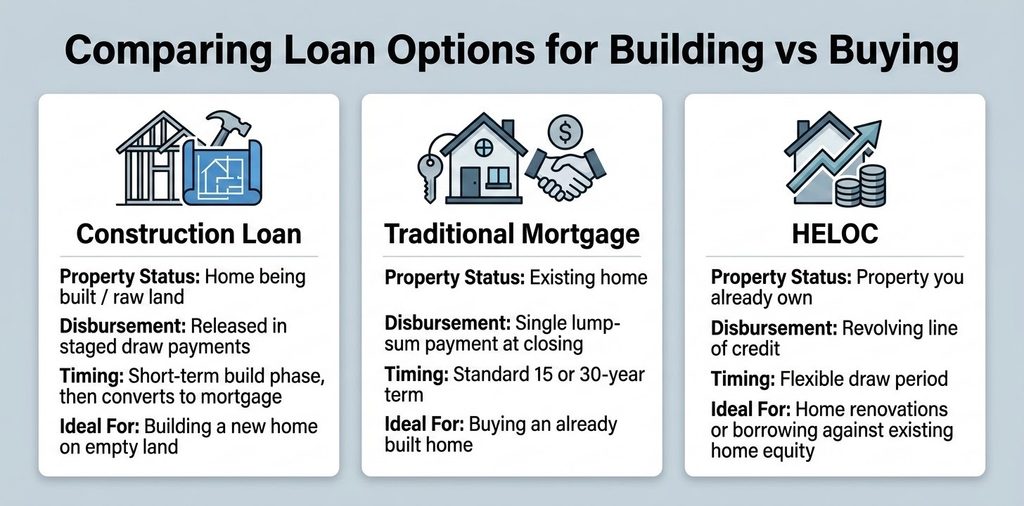
A construction loan vs mortgage comparison starts with timing. A traditional mortgage finances a home that already exists, disbursed in a single payment at closing with one set of paperwork. A construction loan finances a home that’s being built, released in draws as each phase, foundation, framing, roofing, and so on, is inspected and approved, then often converts into a standard mortgage once construction is complete.
The same logic separates a construction loan vs heloc and a construction loan vs home loan. A HELOC and other home equity loans borrow against equity in a property you already own, and a home loan typically means a mortgage on a house that already exists, neither of which works if you’re building on a lot with nothing on it yet. A construction loan is built for that exact gap: financing a home that doesn’t exist yet, released as it gets built.
You’ll also hear it called a building loan or builders loan, depending on the lender. A building loan vs mortgage comparison and a builders loan vs mortgage comparison come down to the same distinction as above. It is the same product with a different name, not a different type of financing.
Below is a table and a graphic for better understanding:
| Loan Type | Property Status | Disbursement Method | Suitability for Raw Lot / New Build | Alternate Names / Also Known As |
| Construction Loan | Home being built / does not exist yet | Released in draws as work/phases (foundation, framing, roofing) are inspected and approved | Built for building on an empty lot; converts to mortgage upon completion | Building Loan, Builders Loan |
| Traditional Mortgage / Home Loan | Home already exists | Disbursed in a single lump sum payment at closing | Not suitable for building on a raw lot with nothing on it yet | Mortgage, Home Loan |
| HELOC / Home Equity Loan | Existing property you already own with equity | Borrows against existing property equity | Not designed to directly finance building on a raw lot | Home Equity Line of Credit |
One-Time Close vs. Two-Time Close
There are two main types of construction loans: one-time close and two-time close. This is where a construction to permanent loan comes in. A one-time close construction loan combines the construction loan and the permanent mortgage into a single closing, with one application, one set of closing costs, and one rate lock that carries through into the permanent loan.
A two-time close means you close on the construction loan first, then close again on a separate mortgage once the home is finished, two applications, two sets of closing costs, and the risk that rates move between the two closings. Most homeowners we work with prefer the one-time close for the simplicity and the single rate lock.
First-Time Home Buyer? Here’s What Changes
A first-time home buyer construction loan works the same way as any other, but the underwriting tends to look more closely at reserves and down payment, since there’s no home sale on the other end to draw from. Some lenders offer first-time buyer programs with lower down payment minimums that apply to construction loans too, worth asking about directly since it’s not something every lender advertises up front.
What to Have Ready Before You Apply
Lenders move faster when you come prepared. A construction loan is a loan requiring more paperwork than a standard mortgage, and most construction loans require two years of tax returns, recent pay stubs, and bank statements, along with a signed proposal from your builder and your construction plans. If you already own the lot, bring the deed and any survey. It is more paperwork than a standard mortgage, since the bank is underwriting a house that doesn’t exist yet.
Construction Loan Timeline: What to Expect
Every project moves at its own pace, but a rough construction loan timeline looks like this: loan approval and rate lock take two to six weeks depending on your lender, permitting and site prep take another two to four weeks, and the build itself runs six to ten months depending on size and scope. During the construction phase, most lenders bill interest only payments on the amount drawn so far rather than the full loan amount, which keeps your monthly payment lower while the home is being built.
Your builder submits a draw request at each milestone, the lender’s inspector confirms the work is complete, and funds typically release within a few business days. We coordinate directly with your lender so those inspections happen without holding up the job site.
How We Work With Your Lender
We are not loan officers, and we will not pretend to be. What we do is walk alongside you through the financing side of any construction project, and make sure the build schedule and the draw schedule stay in sync so nobody’s waiting on the other.
Frequently Asked Questions
What is a construction loan?
A construction loan is short-term financing for building a new home, released to the builder in stages as work is completed rather than all at once.
What’s the difference between a construction loan and a mortgage?
A mortgage finances an existing home in one lump payment. A construction loan finances a home being built, released in draws tied to inspection milestones, and often converts to a mortgage once the home is finished.
What is a one-time close construction loan?
It combines the construction loan and the permanent mortgage into a single closing, with one rate lock and one set of closing costs, instead of closing twice.
Can a first-time home buyer get a construction loan?
Yes. It works the same as any construction loan, though lenders may look closely at reserves and down payment. Some offer first-time buyer programs that apply to construction financing too.
How long does the construction loan timeline take?
Loan approval typically takes two to six weeks, permitting and site prep another two to four weeks, and the build itself six to ten months depending on the size and scope of the home.
How much down payment do I need for a construction loan?
It depends on the lender and loan type, but many construction loans call for a larger down payment than a standard mortgage, often in the 15% to 25% range. Land equity can sometimes count toward that if you already own your lot.